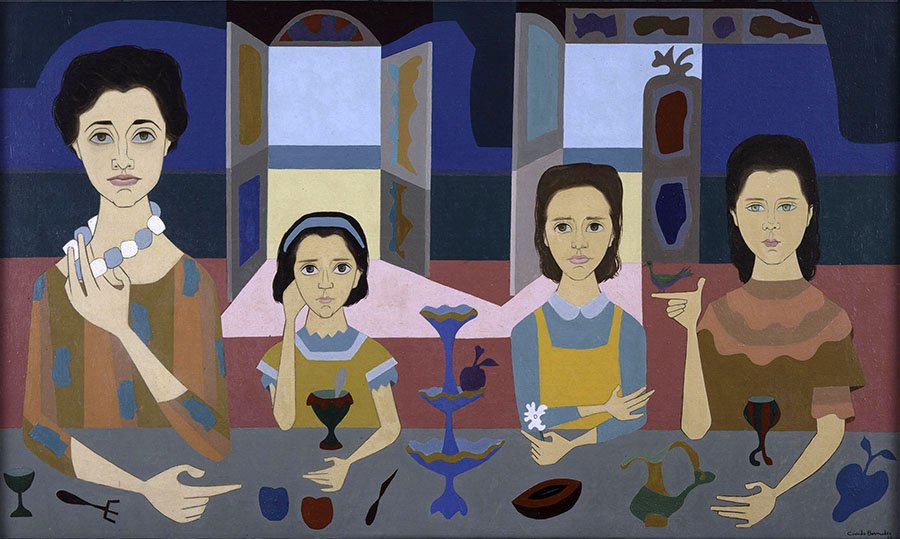
Cundo Bermúdez, ‘Elena y sus Niñas Merendando’, Oil on Canvas, 24 × 40 inches, 1968
About
My name is María Martínez-Cañas, and I am a photo-based artist living and working in Miami, Florida. Throughout my career, my work has explored questions of identity, memory, and personal history—often through the use of collage, archival materials, and photographic experimentation. These themes have long shaped my artistic language, and they resonate deeply with my connection to the José Gómez Sicre Visual Archive, a collection that is not only historically significant but profoundly intertwined with my own life story and creative journey.
I first met José Gómez Sicre in 1968, when I was eight years old. My parents traveled from Puerto Rico—where we were living at the time—to Washington, D.C., so that Cundo Bermúdez could paint a portrait of my mother, my two sisters, and me. Cundo had left Cuba in the early 1960s and settled in Washington at Gómez Sicre’s invitation, living for a time in the basement of his apartment. That early encounter marked the beginning of a lifelong relationship.
Throughout my teenage years, Pepe—as we affectionately called him—visited our home in Puerto Rico often. He became a familiar presence, a family friend whose warmth, intellect, and passion for art left a lasting impression on me. As I grew into my own artistic identity, our relationship evolved into one of mentorship and support.
In December 1982, Pepe invited me to participate in a two-person exhibition at the Museum of Modern Art of Latin America, part of the Organization of American States in Washington, D.C. A few years later, in 1985, he wrote one of my recommendation letters for the Fulbright-Hays Grant, which I ultimately received. His belief in my work was unwavering, and his encouragement accompanied me through the early stages of my career. Until his passing on July 22nd, 1991, he remained one of my strongest advocates.
One of the most profound revelations came years later, in 2003, when I acquired his archive and began to explore its contents in depth. As I opened box after box, I discovered just how essential the medium of photography was to Gómez Sicre—not only in his professional practice, but in the very fabric of his personal life. Photography was not a peripheral tool for him; it was a way of seeing, thinking, documenting, and shaping the narrative of Latin American art.
The archive contains thousands of photographs, negatives, and transparencies that reveal the extent to which he relied on the camera as both witness and companion. Through these images, one can trace his travels, his studio visits, his relationships with artists, and his meticulous attention to visual detail. His photographs informed his writings, grounded his lectures, and guided his curatorial strategies. Even in his personal life, the camera was ever-present—capturing friendships, journeys, and intimate moments rarely reflected in official histories.
For me, as an artist whose own practice engages deeply with archives, memory, and identity, this discovery was transformative. It revealed an unexpected point of connection between us: a shared belief in the power of images to hold history, to question it, and to reimagine it. Understanding how central photography was to Gómez Sicre’s vision has enriched not only my stewardship of the archive but also my own creative work, offering new layers of resonance and dialogue between our lives.
When Pepe passed away, his only heir was his nephew, Horacio Sicre, who inherited not only his extensive art collection but also his complete personal and professional archive—his writings, correspondence, documents, and visual materials. I later acquired the archives directly from Horacio, along with all associated copyrights.
Today, I am honored to serve as the steward of this extraordinary body of material. The José Gómez Sicre Visual Archive stands as a testament to a visionary who championed Latin American artists long before the global art world recognized their significance. Preserving and sharing this archive is both a responsibility and a tribute to the man who played such a meaningful role in my life and whose influence continues to echo through my own artistic practice.